
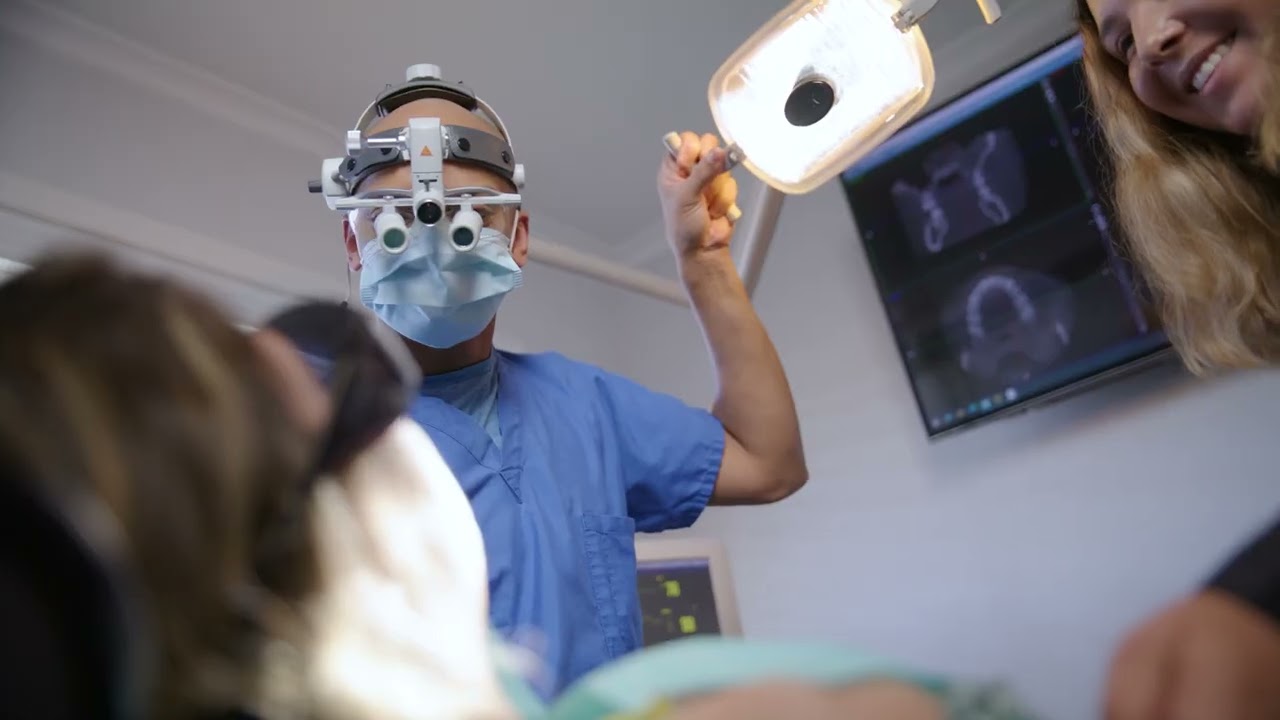
How Much Does a Root Canal Cost in Fayetteville, NC? A 2026 Price Breakdown
Key Takeaways
Most Fayetteville patients are quoted one number for a root canal and then find out at checkout that the crown is a separate bill. This guide prices the whole episode, from the front tooth on the low end to a molar with a post, a build-up, and a crown on the high end.
- A root canal in Fayetteville, NC costs $700 to $1,100 for a front tooth, $800 to $1,300 for a premolar, and $1,000 to $1,700 for a molar.
- The crown that follows adds $900 to $1,900, and the build-up underneath it adds another $200 to $600, which puts a typical molar case at $2,250 to $4,200 all-in.
- TRICARE Dental Program families pay a 30% cost-share on endodontic treatment for pay grades E-1 through E-4 and 40% for E-5 and above, against a $1,500 annual maximum that a root canal and crown can use up in a single pair of visits.
- Most PPO plans in North Carolina cover root canals at 50% to 80% and crowns at 50%, so splitting the two procedures across two plan years can tap two annual maximums when the delay is clinically safe.
- Dr. Jeremiah Davis has performed more than 1,500 dental sedations, and The Teeth Doctors offers four sedation tiers for patients whose anxiety has kept them from treating a painful tooth.
Root canal cost in Fayetteville, NC ranges from $700 to $1,700 for the procedure itself, depending on which tooth needs treatment. Front teeth sit at the low end, and molars at the high end, because molars have three or four canals to clean instead of one. The crown and build-up that follow add another $1,100 to $2,500, putting a typical molar case at $2,250 to $4,200 all-in.
What Does a Root Canal Cost in Fayetteville, NC by Tooth Type?
Root canal cost in Fayetteville, NC is driven almost entirely by canal count: $700 to $1,100 for a front tooth, $800 to $1,300 for a premolar, and $1,000 to $1,700 for a molar. A root canal is a procedure that removes infected or inflamed pulp from inside a tooth, disinfects the empty canals, and seals them so the tooth can stay in your mouth instead of coming out.
Your incisors and canines have one canal each and sit right at the front of the mouth, so they are easy to reach and treat. A first molar can have four canals, some of them curved, sitting behind everything else in your jaw. That is more chair time, more imaging, and more instrumentation, and the fee follows.
It helps to know the billing codes before you call for a quote. Root canal bills are D3310 for a front tooth, D3320 for a premolar, and D3330 for a molar. If you give the front desk the code, you will get a much more specific number than if you ask what a root canal costs in general.
| Tooth Type (CDT Code) | Root Canal Fee | Build-Up or Post | Crown | Full Episode |
|---|---|---|---|---|
| Front tooth (D3310) | $700–$1,100 | $200–$450 | $900–$1,800 | $1,800–$3,350 |
| Premolar (D3320) | $800–$1,300 | $200–$450 | $900–$1,800 | $1,900–$3,550 |
| Molar (D3330) | $1,000–$1,700 | $250–$600 | $1,000–$1,900 | $2,250–$4,200 |
Ranges reflect typical 2026 fees in the Fayetteville market. Your exact fee depends on the tooth, the condition it is in, and your plan.
Why Is the Crown a Separate Bill From the Root Canal?
The crown is a separate bill because the root canal fee covers only the work done inside the tooth, and the crown is a different procedure with its own code. This is the single most common place a Fayetteville patient gets blindsided. You budget $1,200, you pay $1,200, and then you are told the tooth needs a crown in three weeks for another $1,400.
Here is why the crown matters. A back tooth that has had its pulp removed is hollowed out and has lost the structure that used to hold it together. It becomes brittle, and a brittle molar under normal chewing force can split down the root, at which point nothing saves it. The crown caps the tooth and holds it in one piece.
There is usually a third line item between the two. A core build-up (D2950) fills the hollowed-out tooth with a solid resin foundation so a crown has something to grip, and it typically runs $200 to $450. If the tooth has broken off near the gumline, a post and core (D2954) anchors that foundation down into a canal instead, at $300 to $600. You will need one or the other on most molars, rarely both.
Not every tooth needs a crown. A front tooth with a small access opening and most of its structure intact can sometimes be closed with a bonded filling for $200 to $400. Molars and premolars almost always need the crown. Ask for the full treatment plan in writing, with every code on it, before you sit down for the first appointment.
What Does Dental Insurance Cover for a Root Canal in North Carolina?
Most dental plans in North Carolina cover root canals at 50% to 80% and crowns at 50%, after a deductible of roughly $50 to $100 and subject to an annual maximum of $1,000 to $2,000. The three plan structures common among Cumberland County employers behave very differently on the same molar.
On a traditional PPO that treats endodontics as basic care, a $1,300 molar root canal at 80% leaves you around $260. On a plan that files endodontics under major care at 50%, the same tooth leaves you $650. On a DHMO or discount plan, you pay a fixed copay off a schedule instead of a percentage, which is often the lowest number on paper but restricts you to contracted offices.
The annual maximum is where the real damage happens. Take a $1,300 molar root canal plus a $300 build-up plus a $1,400 crown, all in the same plan year. On a plan with a $1,500 cap, the plan pays $1,500 and you pay the remaining $1,500, no matter how generous the coinsurance percentages looked in the benefits booklet.
That points to a practical move. If your tooth is stable and your dentist agrees the timing is safe, finishing the root canal in December and placing the crown in January taps two annual maximums instead of one. This only works when the delay is short and the tooth is protected with a well-sealed temporary in the meantime, because a root-canaled tooth left unrestored for months is a tooth at real risk of fracture. It is a conversation to have with your dentist, not a plan to make on your own.
If you are uninsured, ask about third-party financing before you assume the treatment is out of reach. The Teeth Doctors works with Cherry Patient Financing and CareCredit, and a medically necessary root canal is an eligible expense for FSA and HSA dollars, which lowers the real cost by whatever your tax rate is.
How Does TRICARE Cover a Root Canal for Fort Liberty Families?
The TRICARE Dental Program covers endodontic treatment at a 30% cost-share for pay grades E-1 through E-4 and a 40% cost-share for E-5 and above in the continental U.S., against a $1,500 annual maximum per person. Those figures come straight from the TRICARE cost-share schedule, and they are worth knowing before you walk in, because they are not the same as the percentages a civilian PPO uses.
One clarification first, because it trips up a lot of families at Fort Liberty. Active duty service members get dental care through military dental clinics, not through the TRICARE Dental Program. The TDP is the voluntary plan that covers spouses, children, and National Guard and Reserve members and their families. If you are the sponsor, your care and your family care run on two different tracks.
Now the math on a molar. Say the allowed fee for the root canal is $1,200 and the crown is $1,200. At E-5 and above, endodontics carries a 40% cost-share, so you pay $480 and the plan pays $720. Crowns fall under the Other Restorative category at a 50% cost-share, so you pay $600 and the plan pays $600. The plan has now paid $1,320 of your $1,500 annual maximum, on one tooth, with ten months of the contract year possibly still to go.
Two other lines matter if anxiety is part of the picture. General anesthesia carries a 40% cost-share and IV sedation carries a 50% cost-share under the TDP. Also note that cost-shares are calculated on the allowed fee, not the billed fee, so using a network dentist keeps the number you pay meaningfully lower.
How Much Does Sedation Add to a Root Canal?
Sedation adds roughly $75 to $1,500 to a root canal in Fayetteville, depending on the tier: nitrous oxide sits at the bottom and in-office general anesthesia sits at the top. For a lot of patients this is the line item that decides whether the tooth gets treated at all, so it belongs in the budget conversation and not as an afterthought.
| Sedation Tier | Typical Added Cost | Who It Fits |
|---|---|---|
| Nitrous oxide | $75–$150 | Mild nerves, shorter appointments |
| Oral sedation | $250–$500 | Moderate anxiety, longer visits |
| IV sedation | $500–$900 | Strong anxiety, difficult numbing, multiple procedures |
| General anesthesia (in-office) | $900–$1,500 | Severe dental phobia, complex or combined treatment |
Sedation is billed separately from the root canal. Confirm your tier and fee at the consultation.
Dr. Jeremiah Davis has performed more than 1,500 dental sedations, and The Teeth Doctors is one of the only practices in the Fayetteville area where general anesthesia is delivered in the office by a licensed Dental Anesthesiologist rather than requiring a hospital referral. That matters for the person who has been avoiding the chair for years, because the tooth that finally forces the issue is rarely a simple one by then. Our full guide to sedation dentistry for dental anxiety walks through what each tier feels like and how to prepare.
We see a version of the same story regularly: someone had a bad experience at a dental office years ago, stopped going entirely, and a small cavity that would have been a $200 filling became an abscessed molar. Sedation is what gets that patient through the door. It is an added cost, and it is often the cheapest part of the whole equation once you account for what waiting did to the tooth.
"Most people who come in with a badly broken molar have been chewing on the other side for months. The tooth is usually still savable at that point, but every month of waiting narrows the options and raises the price." Dr. Jeremiah Davis, The Teeth Doctors
Is It Ever Cheaper to Pull the Tooth Instead?
Pulling the tooth is cheaper on the day of treatment, at $150 to $650 for an extraction versus $2,250 to $4,200 for a molar root canal and crown, but it is usually the more expensive decision over a lifetime. That is the honest version of the answer, and it deserves the same honesty in both directions.
The American Association of Endodontists points out that the extraction is only the first bill. A gap in your bite lets neighboring teeth drift and the opposing tooth over-erupt, so most extracted teeth need replacing. A single implant with a crown runs $3,000 to $6,000, and a three-unit bridge is not far behind. You may also need a bone graft at $300 to $800 to preserve the socket in the meantime. Compare those figures against the dental bridge cost in the NC article before you decide.
The durability data supports saving the tooth when it is savable. A systematic review indexed in the National Library of Medicine found that root-canal-treated teeth had a pooled survival probability of about 93% at four to five years and about 87% at eight to ten years. That is a strong return on a tooth people are routinely told to give up on.
That said, extraction is sometimes the right call, and any dentist who tells you otherwise is not being straight with you. A tooth with a vertical root fracture cannot be saved. A tooth with decay running well below the bone level has nothing left to hold a crown. A tooth with hopeless gum support is going to come out eventually regardless. And a second molar at the very back sometimes does not need replacing at all, which changes the math entirely. Ask your dentist specifically whether the tooth is restorable, and ask what the replacement plan would be if it is not.
What Happens to the Cost If You Wait?
Waiting raises the cost, because a tooth that needed a straightforward root canal in the spring often needs a post and a crown by the fall, and sometimes needs extraction and replacement instead. Deferred dental treatment is the norm around here, not the exception, and the pattern is predictable enough that it is worth spelling out.
A tooth that develops a visible infection at the root tip before treatment has a measurably lower long-term survival rate than one treated before that point. If the first root canal fails, retreatment adds another $1,000 to $1,800, and if retreatment will not work, the next stop is apical surgery or removal. Each step costs more than the one before it.
One more thing worth saying plainly: an emergency room cannot fix a tooth. An ER can drain an abscess, hand you antibiotics, and manage the pain, and then you still need the root canal, having paid for the visit. The Teeth Doctors keep same-day emergency appointments available for exactly this reason. If you have already been managing a painful tooth for weeks, the root canal service page explains what the appointment entails.
If you want a plain-English walkthrough of the procedure from a neutral source, the ADA patient guide to root canals and the Cleveland Clinic overview both explain what happens in the chair without trying to sell you anything.
Where to Get a Root Canal in Fayetteville, NC
For patients in Fayetteville, Fort Liberty, and Hope Mills who need a root canal but have been putting it off because of cost or fear of the chair, The Teeth Doctors is one of the only area practices offering four tiers of sedation, including general anesthesia delivered in-office by a licensed Dental Anesthesiologist. Dr. Jeremiah Davis has completed more than 1,500 dental sedations and holds Mastership from the Academy of General Dentistry. The practice keeps same-day emergency appointments open, completes both the root canal and the crown under one roof, and works with Cherry Patient Financing, CareCredit, and FSA/HSA funds.
Medically reviewed by Dr. Jeremiah Davis, MAGD, FAAID, DABOI/ID
Dr. Davis is a Master of the Academy of General Dentistry, a Dawson Academy Scholar, and a United States Army Veteran who has performed more than 1,500 dental sedations for patients across Fayetteville, Fort Liberty, and Hope Mills. Dr. Jeremiah Davis provider page
The Teeth Doctors™ – Worry-Free from A to Z™ Dental Experience
Providing five-star-rated dental care for families in Fayetteville, The Teeth Doctors™ focus on comfort, communication, and exceptional oral health.
- Family & Preventive Dental Care
- Implant & Teeth Replacement Dental Care
- Cosmetic Dental Care
- Sedation Dentistry
- Smile Transformation Gallery
Read Our Reviews | Meet Our Dentists