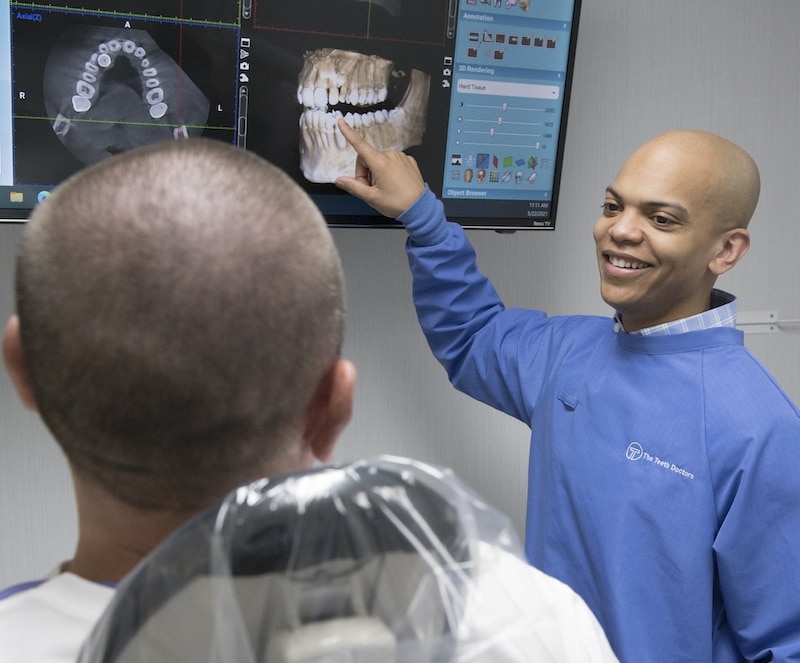

If your dentures slip when you eat, click when you talk, or leave your gums sore by the end of the day, implant-supported overdentures fix the root cause. They lock onto two or more small dental implants set in your jawbone, so the appliance stays put without paste, without rocking, and without the daily anxiety of wondering if you can bite into something solid. The Teeth Doctors is roughly 26 minutes south of Anderson Creek on US-401, and Dr. Jeremiah Davis holds implant credentials that fewer than 10 dentists in North Carolina can match. That combination of distance, credential depth, and outcomes is why Anderson Creek patients make the drive instead of settling for a generic denture down the road.

Why Anderson Creek Patients Drive to Dr. Davis for Overdentures
Anderson Creek sits roughly 19 miles north of our office in west Fayetteville. The drive takes about 26 minutes down US-401 South, give or take a few minutes depending on Spring Lake traffic. For a procedure that touches your daily comfort, chewing function, and confidence in public for the next decade or more, 26 minutes is not a long way to go. The question is what you get for that drive.
Most general dentists in any community can take an impression and order a conventional denture from a lab. What Anderson Creek patients are choosing when they come to The Teeth Doctors is access to a single dentist who has earned essentially every advanced credential the implant-dentistry field offers, who plans implant positions personally using surgical guides, and who has been doing this work full-time for over a decade. Dr. Davis is one of only eight dentists in North Carolina who holds Diplomate status from the American Board of Oral Implantology (DABOI/ID), which is the highest credential in implant dentistry recognized in the United States.
For an Anderson Creek patient comparing a closer generalist against a 26-minute drive to a master-level implant dentist, the credential gap is the entire argument. Overdentures sit at the intersection of prosthetics and surgery. If the implants are positioned wrong, the prosthetic will fail no matter how well it is made. If the prosthetic is designed wrong, the implants will overload. You want one person who has trained extensively on both sides of the procedure planning your case.
Implant Credentials That Set Dr. Davis Apart
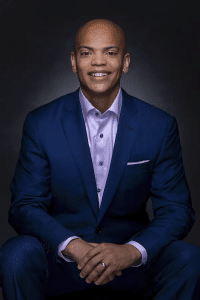
Dr. Jeremiah C. Davis, DDS, MBA, brings the following credentials to every overdenture case:
- United States Army veteran, 82nd Airborne Division
- Master of the Academy of General Dentistry (MAGD), held by fewer than 2 percent of general dentists in the U.S. and Canada
- Diplomate of the American Board of Oral Implantology (DABOI/ID), held by only 8 dentists in the entire state of North Carolina
- Fellow of the American Academy of Implant Dentistry (FAAID)
- Master of the International Congress of Oral Implantologists (MICIO)
- Master of the Academy of Osseointegration (AO)
- Surgical Master of the Interdisciplinary Dental Education Academy, held by only 8 dentists in the United States
- Dawson Academy Scholar
- Named one of America's "Top 40 Dentists Under 40" by Incisal Edge magazine
- DDS from UNC Chapel Hill School of Dentistry, MBA from UNC Kenan-Flagler Business School
Dr. Davis served as a captain in the U.S. Army's 82nd Airborne Division at the installation now known as Fort Bragg. After his service, he completed dental school at UNC Chapel Hill and added an MBA from UNC Kenan-Flagler. He has practiced in both private and public dental care settings and is a father of seven. He chose Fayetteville to build his practice and stayed.
What Are Overdentures and Who Are They For?
An overdenture is a removable denture that snaps onto two or more dental implants placed in your jawbone. Unlike a conventional denture that rests on your gums and depends on suction or adhesive to stay in place, an overdenture clips onto small attachment points (abutments) anchored in bone. The result is a denture that does not move when you eat, does not slip when you laugh, and does not need adhesive paste.
Overdentures work well for patients who are missing all the teeth in an arch (upper, lower, or both) and who want stability that a conventional denture cannot give them. They also work for patients whose current dentures have become loose because the underlying jawbone has shrunk over years of wear. Tooth-supported variants exist for patients who still have a few healthy natural teeth and want to preserve them rather than extract.
Overdentures cost less than a fixed full-arch solution like All-on-4 because they typically use fewer implants (two to four per arch versus four to six) and the prosthetic is removable rather than permanently fixed. For many Anderson Creek patients, overdentures are the practical entry point into implant dentistry: dramatically better than a traditional denture, less invasive and less expensive than a fixed bridge.
Implant-Supported vs. Tooth-Supported Overdentures
Two main configurations cover the majority of cases:
Implant-supported overdentures. The denture clips onto two to four dental implants placed in your jawbone. This is the more common option and the one most Anderson Creek patients ask about. It works whether or not you have any remaining natural teeth, because the implants do the work of holding the denture in place. Bone density determines if implants can be placed directly or if a bone graft is needed first.
Tooth-supported overdentures. If you still have a few healthy natural teeth in the arch you want to restore, those teeth can be prepared (typically with root canal treatment and reshaping) to serve as anchors for the overdenture. This option preserves your remaining teeth and can be appropriate when those teeth are in good positions and have solid roots. Dr. Davis will evaluate which approach fits your case during the consultation.
Your Overdenture Process Step by Step
Every case is different, but the overall path from first consultation to final delivery typically looks like this:
- Consultation and CBCT scan. Dr. Davis examines your mouth, takes a 3D cone-beam scan to evaluate bone density and anatomy, and discusses your goals. You will know during this first visit if implant-supported overdentures are an option for you and roughly what the case will look like.
- Treatment plan and case design. We map out implant positions, abutment selection, and the prosthetic design before any surgery. Dr. Davis uses surgical guides for implant placement on essentially every case.
- Implant placement. The implants are placed under local anesthesia, with sedation options available for patients who request it. Most cases take 60 to 90 minutes per arch.
- Healing and osseointegration. Your jawbone needs three to six months to fuse to the implants. During this period, you wear an interim denture so you are never without teeth.
- Abutment connection and impressions. Once the implants are integrated, we connect the abutments and take impressions for your final overdenture.
- Final delivery. Your custom overdenture is fitted, adjusted for bite, and you leave with a denture that snaps securely onto your implants.
Caring for Your Overdentures Day to Day
Care is straightforward once you settle into a routine:
- Remove the overdenture once a day, rinse it under warm water, and brush it gently with a soft brush and non-abrasive cleaner.
- Brush your remaining gums, tongue, and any natural teeth with a regular soft toothbrush. The implants themselves still need attention around the abutments.
- Soak the overdenture overnight in a denture-cleaning solution or plain water. Never use hot water, which can warp the acrylic.
- Come in every 6 months for a professional cleaning and to have the attachment retention checked. The clips inside the denture wear over time and we replace them as needed.
- Call us right away if the overdenture starts feeling loose, if an attachment breaks, or if you notice irritation around an implant.
Anderson Creek Overdentures Office Tour
Overdenture Questions Anderson Creek Patients Ask
Is the drive from Anderson Creek to Fayetteville worth it for overdentures?
For most patients, yes. The 26-minute drive happens roughly 4 to 6 times during the active treatment phase (consultation, surgery, follow-ups, impressions, delivery), then twice a year for cleanings. For a procedure that affects your daily quality of life for 10 to 20 years, that's a small total investment of driving time in exchange for access to one of the most credentialed implant dentists in the state.
How many implants will I need for my overdenture?
Most overdenture cases use two implants for a lower arch and four implants for an upper arch. The exact number depends on your bone volume, the type of attachment system, and how stable you want the denture to feel. Dr. Davis will confirm the number at your consultation after reviewing your CBCT scan.
How long does the full process take from consultation to final delivery?
Most patients are 4 to 7 months from first consultation to final overdenture delivery. The longest part is the healing period after implant placement, which is 3 to 6 months while your bone integrates with the implants. You wear an interim denture during this time.
Will my overdenture ever feel loose again?
The clips inside the overdenture wear down over time and need to be replaced every 1 to 3 years for most patients. This is a quick chair-side swap. The underlying implants typically stay solid for 20-plus years with good hygiene.
Does insurance cover overdentures?
Most dental insurance plans cover a portion of the denture itself but not the implants underneath. We accept CareCredit financing and offer the Friends and Family Membership Plan as an option for patients without insurance. We will run your benefits and give you a clear out-of-pocket number before you commit to any work.
Schedule Your Anderson Creek Overdenture Consultation
Call 910-864-4646 to schedule your consultation, or use the appointment form. The first visit includes a clinical exam, a CBCT scan, a frank conversation about your options, and a written cost estimate. You will not leave that visit confused about what comes next.
Hear From Real Patients...


Schedule today!
(910) 864-4646
6402 Yadkin Rd.
Fayetteville, NC
Complete New
Patient Forms