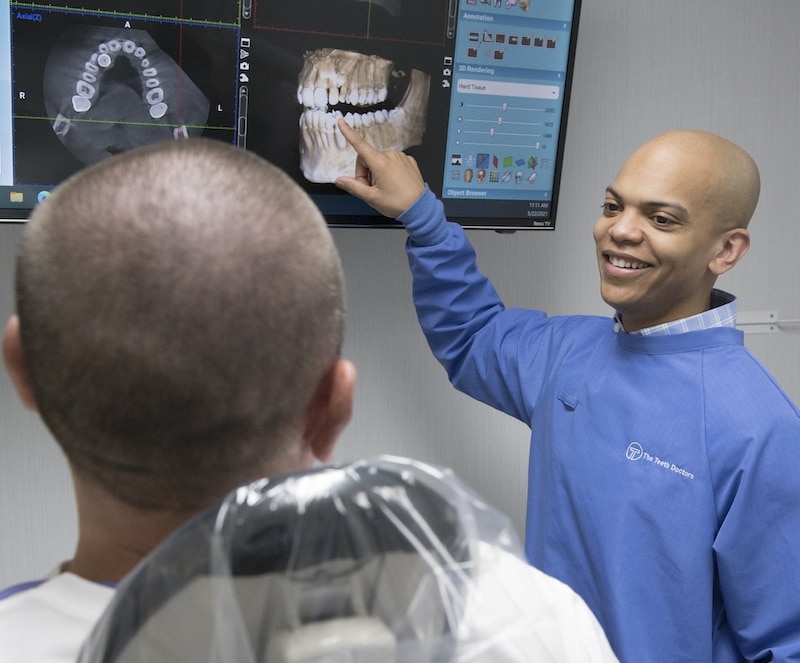

When a tooth is too damaged, too painful, or too crowded to save, removal becomes the right choice. At The Teeth Doctors in Fayetteville, NC, just a short drive from Anderson Creek, Dr. Jeremiah Davis performs simple and surgical tooth extractions with a calm, methodical approach and full sedation options for patients who want them. You will know what to expect at every step, and you will leave with a clear plan for what comes next.
Call (910) 864-4646 to schedule a consultation.
Why Anderson Creek Patients Choose Dr. Davis for Extractions
A veteran dentist with surgical implant credentials
Dr. Jeremiah Davis is a US Army veteran and former member of the 82nd Airborne Division. After his military service, he pursued advanced training in surgical dentistry and implant therapy. Today he holds credentials very few general dentists carry:
- Diplomate of the American Board of Oral Implantology / Implant Dentistry (DABOI/ID)
- Fellow of the American Academy of Implant Dentistry (FAAID)
- Master of the Academy of General Dentistry (MAGD)
- Master of the International Congress of Oral Implantologists (MICOI)
- Master of the Academy of Osseointegration (AO)
- Surgical Master of the Interdisciplinary Dental Education Academy
- Dawson Academy Scholar
- Voted Top 40 Dentists Under 40
These credentials matter for extractions specifically because so many extractions are step one of a longer plan. Bone grafting, immediate implant placement, ridge preservation, and full-arch reconstruction all begin with how the tooth comes out. A surgical specialist plans the extraction with the next step already in mind.
One practice for extraction, sedation, and replacement
If your extraction leads to a need for a dental implant, a bridge, or a denture, Dr. Davis can plan and place that restoration at the same practice. You will not be referred out to a separate oral surgeon, and you will not start over with a new doctor in a new office. The patient record stays in one place, and the surgical plan is consistent from day one to final restoration.
Types of Tooth Extractions We Perform
Simple extractions
A simple extraction removes a tooth that is fully visible above the gumline and has straightforward root anatomy. Dr. Davis numbs the area with local anesthetic, gently loosens the tooth from its socket, and lifts it out with extraction forceps. Most simple extractions take 15 to 30 minutes from start to finish.
Surgical extractions
Surgical extractions are needed when a tooth is broken at the gumline, has unusual root anatomy, or is impacted below the gum or bone. These cases involve a small incision in the gum tissue and, sometimes, removal of a small amount of bone around the tooth. Surgical extractions take longer than simple ones and recovery is a bit more involved, but the procedure itself is well-controlled. This is the area where Dr. Davis's surgical training shows clearly.
Wisdom tooth removal
Third molars often cause crowding, pain, decay in neighboring teeth, or gum infection. Dr. Davis evaluates each wisdom tooth on its own (some are fine to leave alone) and removes those that pose a risk. Most patients have all four removed in a single visit under IV sedation, then recover at home over the following few days.
Multiple-tooth extractions
Some patients need several teeth removed in one appointment, either because of widespread decay, advanced periodontal disease, or as the first step toward a full-arch implant treatment. Planning is the key here. The order of removal, the timing of any bone grafting, and the immediate management of the empty space all get worked out before the appointment begins.

What to Expect at Your Anderson Creek Tooth Extraction Visit
Consultation and imaging
Your first visit starts with a focused exam and digital X-rays. For more complex cases, a 3D cone beam scan gives Dr. Davis a clear picture of the tooth, its roots, and the bone around it. This is also when you talk through your sedation preferences, any health conditions or medications that matter, and what you want to happen after the tooth is out.
The day of the procedure
Plan to arrive a few minutes early to settle in. You will be brought back, given local anesthetic, and (if you have chosen sedation) helped to a comfortable state of relaxation. Dr. Davis performs the extraction. Gauze is placed at the site, post-op instructions are walked through with you and any family member who came along, and you head home. Most patients are out within 90 minutes of arriving.
Follow-up
A short check-in by phone or in-person follow-up is scheduled based on the complexity of the case. If a bone graft or future implant is part of your plan, you leave with the timeline already mapped out.
Sedation Options for Anxious Patients
Dental anxiety is one of the most common reasons people put off treatment. Our Worry Free from A to Z approach is designed to take that off the table. Sedation options at the practice include:
- Local anesthetic alone, for patients who want to stay fully alert
- Nitrous oxide (laughing gas), for mild relaxation that wears off quickly
- Oral sedation, for deeper relaxation with a pill taken before the appointment
- IV sedation, for the deepest level of relaxation and the easiest recovery for longer procedures
Dr. Davis will recommend the approach that fits your case, your health history, and your comfort level. If you are nervous about the procedure, please say so during the consultation. The choice of sedation is a conversation, not a script.
Healing and Aftercare
The first 24 hours
A blood clot forms in the socket within the first few hours. That clot is what your body uses to start rebuilding bone, so protecting it matters. Keep the gauze in place for as long as instructed, avoid rinsing forcefully, and skip drinking through a straw. Eat soft foods. Rest with your head slightly elevated.
Days two through seven
Swelling and mild soreness are normal in the first couple of days and improve from there. Over-the-counter pain relievers handle most cases. If Dr. Davis prescribed something stronger for a more complex extraction, follow that prescription. Gently rinse with warm salt water starting 24 hours after the procedure. Skip smoking and vigorous exercise until cleared.
When to call us
Call (910) 864-4646 if you notice unusual swelling, bleeding that has not slowed after several hours, a fever, or sharp pain that gets worse instead of better around day three to four. The last symptom is sometimes a sign of dry socket, which is uncomfortable but very treatable in our office.
Cost, Insurance, and Financing
Tooth extraction cost depends on the complexity of the case (a simple extraction is priced differently than a full bony impaction), whether sedation is used, and whether bone grafting or other adjunct procedures are part of the plan. Dr. Davis will give you a clear written estimate at the consultation, before you commit to anything.
We accept most major dental insurance plans and file claims on your behalf. For patients without insurance or with limited coverage, two options are commonly used at the practice:
- The Friends and Family Membership Plan, an in-house plan that covers preventive care and offers real discounts on treatment, including extractions.
- CareCredit, a third-party healthcare financing program with promotional periods that let you spread payments over time.
If finances are a concern, please say so. There are almost always more options than a patient expects.
Anderson Creek Tooth Extraction Office Tour
Our Anderson Creek Dental Services Include:

Anderson Creek Tooth Extraction FAQs
How long does a tooth extraction take?
A simple extraction is usually 15 to 30 minutes from start to finish. Surgical extractions, including wisdom teeth, run longer (typically 30 to 60 minutes), and multiple-tooth extractions take longer still depending on the case.
Will the extraction hurt?
The procedure itself should not hurt. Dr. Davis fully numbs the area with local anesthetic before any instruments touch the tooth, and patients who choose sedation often have no memory of the procedure at all. Soreness after the anesthetic wears off is normal and is handled with the medication regimen given to you at discharge.
How long is recovery?
Most patients feel substantially better within three to four days. Soft tissue closes over the socket within one to two weeks. Full bone healing takes several months, which is the reason any implant placement is timed to the bone, not the calendar.
Can I drive myself home?
Yes, if you have only had local anesthetic or nitrous oxide. No, if you have had oral or IV sedation. Please arrange a ride in advance if sedation is part of your plan.
What if I want to replace the tooth after extraction?
Dr. Davis can plan implant placement, bridges, or removable options at the same consultation. In many cases, bone grafting at the time of extraction preserves the bone for a future implant. The earlier this is discussed, the more options you have.
Schedule Your Consultation
If you are dealing with a problem tooth and you live in or near Anderson Creek, the next step is a focused consultation. We will look at the tooth, walk through your options, and give you a clear written estimate before you decide anything.
Call (910) 864-4646 or request an appointment online. Office hours are Monday through Thursday, 9 AM to 4 PM, and Friday 10 AM to 4 PM.
- Anderson Creek Tooth Extraction Near You
- Dunn Tooth Extraction Near You
- Eastover Tooth Extraction Near You
- Fayetteville Tooth Extraction Near You
- Fort Liberty Tooth Extraction Near You
- Hope Mills Tooth Extraction Near You
- Laurinburg Tooth Extraction Near You
- Pinehurst Tooth Extraction Near You
- Pope Field Tooth Extraction Near You
- Raeford Tooth Extraction Near You
- Sanford Tooth Extraction Near You
- Southern Pines Tooth Extraction Near You
- Spout Springs Tooth Extraction Near You
- Spring Lake Tooth Extraction Near You
- Vander Tooth Extraction Near You
Hear From Real Patients...


Schedule today!
(910) 864-4646
6402 Yadkin Rd.
Fayetteville, NC
Complete New
Patient Forms