How to Choose the Right Denture for Your Situation
There are four main paths for replacing missing teeth with dentures, and which one fits depends on what you have left, how much bone is in your jaw, your overall health, and your budget. The short version:
- You are missing a few teeth, not all of them: partial dentures are the usual answer.
- You are missing all your teeth on one or both arches: traditional removable dentures are the budget option, implant-supported dentures are the long-term option.
- You have worn dentures for years and they no longer fit: this is a foundation problem, not a denture problem. Implant-supported dentures fix it.
- You need teeth removed and do not want to spend healing time without teeth: immediate dentures go in the same day as the extractions.
The rest of this page walks through each option in plain language so you know which conversation to have at your consultation.
Removable Dentures (Full and Partial)
Traditional removable dentures rest on your gums, held in place by suction (upper) or by your natural mouth movements (lower). Partial dentures clip to your remaining natural teeth with metal or flexible clasps. Both types come out for cleaning. Both have been around for decades and remain the most affordable way to replace missing teeth.
When traditional removable dentures are the right choice
Removable dentures work well if your budget is the deciding factor, if your medical history rules out implant surgery, or if you have worn dentures successfully in the past and want to stay with what works for you. They are also the right answer if you have plenty of healthy bone and your existing dentures simply need to be remade with current materials.
When they are not
Removable dentures slip. They cover the roof of your mouth (upper) or feel bulky (lower). They restore about 25 to 30 percent of the chewing force of natural teeth, which means certain foods become harder to eat. Over the years, your jaw bone shrinks because there are no tooth roots loading it; this is why dentures that fit well at first start to feel loose after five to ten years. If any of these are dealbreakers for you, look at implant-supported options instead.
Implant-Supported Dentures
Implant-supported dentures use dental implants placed in your jaw bone as anchors. Your denture clips, snaps, or screws onto those implants instead of resting on your gums. The result is a set of teeth that does not slip, gives you back most of your natural chewing force, and keeps your jaw bone from shrinking the way it does under traditional dentures.
Two main approaches:
Snap-in (overdenture) implants
Two to four implants per arch with a denture that snaps on and off. You take it out at night for cleaning. This is the entry-level implant-supported option, less expensive than fixed full-arch, and works well for most patients who are tired of slipping but do not want fixed teeth. For a deeper look at this approach see [internal link to /fayetteville-implant-dentist/implant-dentures/].
All-on-4 and fixed full-arch
Four implants per arch hold a complete fixed set of teeth. The teeth do not come out; only your dentist can remove them. The angled placement of the rear implants often lets the prosthetic use the bone you still have, sometimes avoiding the need for grafting. For patients who have been told they need extensive grafting before implants, All-on-4 is sometimes a path that avoids that. For a full breakdown of how the procedure works, [internal link to /2024/10/31/all-on-four-dental-implants/ or the All-on-4 service page].
Immediate Dentures After Extraction
If you need teeth removed and you do not want to spend the healing period with no teeth, immediate dentures go in the same day as the extractions. They function as a temporary while your gums heal over the following months. We then reline or remake the final set after everything has settled, usually at six to nine months.
The trade-off: more visits in year one, but you never go without teeth in public. For most patients in working-age life, that trade is worth it.
Why Fayetteville Patients Choose The Teeth Doctors
Dr. Davis's credentials
Dr. Jeremiah Davis holds five master-level and board credentials in implant dentistry: Master of the Academy of General Dentistry (MAGD), Fellow of the American Academy of Implant Dentistry (FAAID), Diplomate of the American Board of Oral Implantology (DABOI/ID), Master of the International Congress of Oral Implantologists (MICOI), and Master of the Academy of Osseointegration (AO). The DABOI/ID is the gold standard board certification for implant dentistry in the United States and is held by a small percentage of dentists nationally.
Combined with the four mastership credentials and Dawson Academy scholar training in occlusion and full-mouth reconstruction, this represents about a decade of post-dental-school continuing education focused on implant and full-arch work. For most denture decisions, including all-removable cases, this depth of training shows up in the consult. We will tell you what your case actually needs, including when a simpler option is the right one.
Cost, Insurance, and Financing
Denture costs in Fayetteville vary widely based on what you choose. Traditional removable dentures are the most affordable. Implant-supported dentures cost more upfront but typically last longer and preserve the bone in your jaw. We give you a written estimate at consultation, before any treatment starts. We do not quote prices over the phone because every case differs.
We accept most major dental insurance plans (call to confirm yours). For uninsured patients, our Friends and Family Membership Plan covers preventive care and offers a discount on procedures including dentures and implants. CareCredit financing is available for cases where insurance does not cover the full balance.
Sedation Options
Many denture patients have put off dental work for years. Sedation makes the difference between getting it done and putting it off again.
- Oral sedation: a pill before your appointment that takes the edge off. You stay awake but relaxed. Plan to have a driver.
- Nitrous oxide (laughing gas): wears off within minutes after your appointment. You can drive yourself home.
- IV sedation: for full-arch implant placement, complex grafting, or serious dental anxiety. You sleep through the procedure and need a driver.
Fayetteville Dentures Office Tour
Our Fayetteville Dental Services Include:

Frequently Asked Questions
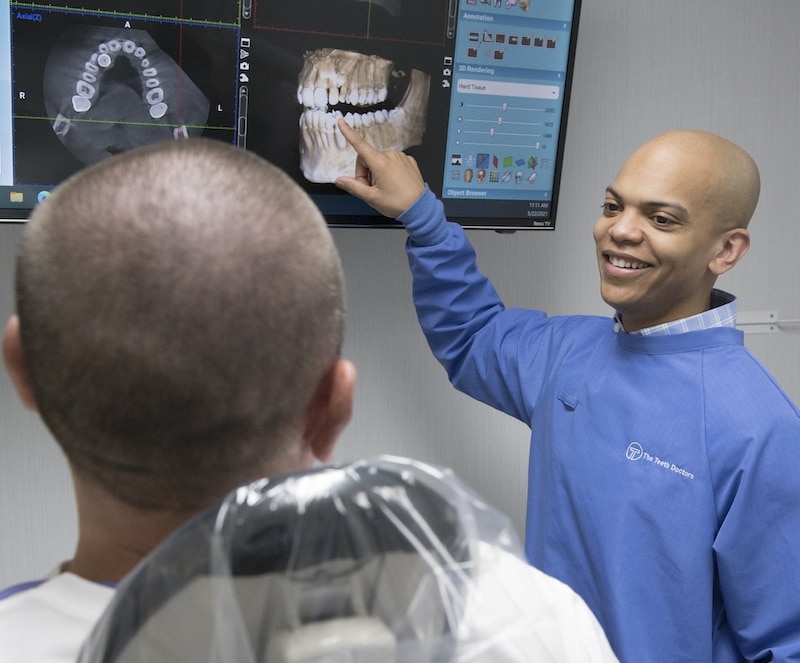
These eight questions cover the most common things Fayetteville patients ask about dentures. The same eight should be marked up with FAQPage schema for the chance at FAQ rich results in search.
How long do dentures last?
Traditional removable dentures typically last five to ten years before they need to be remade. Implant-supported dentures last considerably longer; the implants themselves can last decades when cared for, and the prosthetic on top is usually replaced every ten to fifteen years. The shorter lifespan of traditional dentures comes down to your jaw bone, not the denture itself: bone shrinks under removable dentures because there are no tooth roots loading it, and after five to ten years the same denture no longer fits the changed shape underneath.
How much do dentures cost in Fayetteville?
Costs depend on the type of denture, the materials, whether you need extractions or grafting first, and whether you need sedation. We give you a written estimate at consultation, before any treatment starts. We do not quote prices over the phone because every case differs and a number quoted without an exam is rarely accurate. Generally, traditional removable dentures are the most affordable path; implant-supported dentures cost more upfront but typically last longer.
Does insurance cover dentures?
Most major dental insurance plans cover some portion of removable dentures, often around 50 percent up to a yearly maximum. Implant work is covered less generously; many plans cap implant coverage well below the actual cost of the procedure. We file claims for you and tell you upfront what your specific plan will and will not pay. If you do not have insurance, our Friends and Family Membership Plan offers a discount path for preventive care and procedures.
What is the difference between implant-supported dentures and All-on-4?
All-on-4 is one specific approach to implant-supported dentures. Implant-supported dentures is the broader category, which includes options ranging from two implants holding a snap-in denture (the entry-level approach) up to six or eight implants holding a fully fixed bridge (the most robust approach). All-on-4 sits in the middle: four implants per arch hold a fixed full set of teeth that does not come out. The choice between snap-in, All-on-4, and All-on-6 depends on your bone, your bite forces, and your budget. We walk through the options at the consultation based on your 3D scan.
Can I get same-day dentures?
Two different things go by this name. Immediate dentures, placed the same day as extractions, are widely available; we offer them and they work as a temporary while your gums heal. Same-day implant teeth, where the implants and a temporary fixed prosthetic go in on the same surgical day, are an All-on-4 option for patients whose bone density supports it. The final permanent prosthetic on an All-on-4 case still goes on after the implants integrate at three to six months. Same-day teeth and case-completed-in-one-day are not the same thing.
Will my dentures look natural?
Modern denture materials look much more natural than the dentures most people remember from their grandparents. Tooth shape, size, color, and gum tissue tone are all customizable. We take photos and measurements at the consultation and you have the chance to approve the look before the final dentures are made. If you have old photos of yourself before tooth loss, bring them; they help us match your original smile if that is what you want.
How long does the whole process take?
A standard removable denture is about four appointments over four to six weeks. Immediate dentures can be ready the day of your extractions, with adjustments in the months that follow. Implant-supported cases run three to six months from the start of treatment to the final permanent prosthetic, longer if you need bone grafting before implants can be placed. We coordinate scheduling to consolidate visits where possible and lay out the full timeline at consultation so you know what to expect.
What happens if my dentures stop fitting?
Removable dentures stop fitting eventually because the bone underneath them shrinks. Three options when that happens: reline (a new lining inside the existing denture, the cheapest fix), remake (a brand new denture made to fit your current bone shape), or transition to implant-supported dentures (the foundation fix that prevents further bone loss). Which option makes sense depends on the condition of your existing denture and how much bone you have left. Bring your current denture to the consultation and we will tell you honestly which path is right for you.
Schedule Your Consultation
Call (910) 864-4646 or request an appointment online. We are open Monday through Thursday 9 AM to 4 PM and Friday 10 AM to 4 PM. The office is at 6402 Yadkin Road in Fayetteville.
- Anderson Creek Dentures Near You
- Dunn Dentures Near You
- Eastover Dentures Near You
- Fort Liberty Dentures Near You
- Hope Mills Dentures Near You
- Laurinburg Dentures Near You
- Pinehurst Dentures Near You
- Pope Field Dentures Near You
- Raeford Dentures Near You
- Sanford Dentures Near You
- Southern Pines Dentures Near You
- Spout Springs Dentures Near You
- Spring Lake Dentures Near You
- Vander Dentures Near You
Hear From Real Patients...


Schedule today!
(910) 864-4646
6402 Yadkin Rd.
Fayetteville, NC
Complete New
Patient Forms